
Hardox vs China NM Wear Plate: The Definitive Comparison for 2026
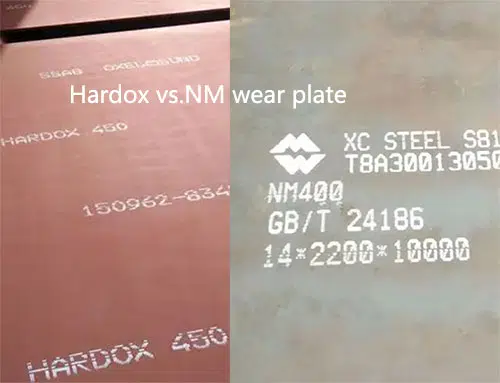
Table of Contents
In the world of heavy industry—mining, construction, and recycling—choosing the right abrasion-resistant (AR) steel isn’t just a technical decision; it’s a bottom-line one. The debate usually centers on two heavyweights: the Swedish-born Hardox® (by SSAB) and the versatile Chinese NM series (NM400, NM450, NM500).
But does the “premium” price of Hardox always translate to better value? Or is Chinese NM steel now the smarter choice for modern procurement? Let’s break down the technicalities.
1. Brand Identity vs National Standards
The first major difference lies in how these steels are regulated.
- Hardox®: This is a branded product. SSAB maintains strict internal global standards. When you buy Hardox 450, the chemical composition and mechanical properties are guaranteed to be identical whether you are in Europe, the US, or Asia.
- China NM Series: “NM” stands for Nai Mo (wear-resistant). It is a national standard (GB/T 24186). This means multiple mills (like Baosteel, Xingcheng, or Wuyang) produce it. While they all meet the minimum hardness requirements, there can be slight variations in chemistry and “cleanliness” between different Chinese manufacturers.
2. Technical Comparison: Hardness & Toughness
Both steels use the Brinell scale (HBW) to denote hardness. An NM450 plate and a Hardox 450 plate both aim for a nominal hardness of 450 HBW. However, “hardness” is only half the story.
The Toughness Gap
Impact toughness is where Hardox often maintains a lead.
- Hardox is designed to remain ductile even at sub-zero temperatures (down to -40°C), making it ideal for equipment operating in extreme climates or facing high-impact shocks (e.g., primary crushers).
- Chinese NM plates offer excellent sliding abrasion resistance but may have lower impact energy ratings at extreme cold. For standard environments and sliding wear (e.g., hoppers, chutes), NM is often more than sufficient.
Charpy Impact Test Comparison Table: NM450 vs Hardox 450
| Material Grade | Manufacturer | Test Temperature | Guaranteed Impact Energy (KV₂) | Typical Measured Impact Energy (KV₂) | Hardness (HBW) |
|---|---|---|---|---|---|
| Hardox 450 | SSAB | +20°C | ≥ 60 J | 80–100 J | 425–475 |
| 0°C | ≥ 55 J | 70–90 J | |||
| -20°C | ≥ 50 J | 60–80 J | |||
| -40°C | ≥ 40 J | 50–65 J | |||
| BNM450 | Baosteel | +20°C | ≥ 34 J | 45–60 J | 420–480 |
| 0°C | ≥ 30 J | 40–55 J | |||
| -20°C | ≥ 27 J | 35–50 J | |||
| -40°C | ≥ 20 J | 25–35 J | |||
| WNM450 | HBIS Wuyang Steel | +20°C | ≥ 34 J | 40–55 J | 420–480 |
| 0°C | ≥ 30 J | 35–50 J | |||
| -20°C | ≥ 27 J | 30–45 J | |||
| -40°C | ≥ 18 J | 22–30 J | |||
| NM450 | Xingcheng Special Steel | +20°C | ≥ 34 J | 42–58 J | 420–480 |
| 0°C | ≥ 30 J | 38–52 J | |||
| -20°C | ≥ 27 J | 32–48 J | |||
| -40°C | ≥ 20 J | 26–36 J | |||
| NNM450 | NISCO | +20°C | ≥ 34 J | 38–52 J | 420–480 |
| 0°C | ≥ 30 J | 33–47 J | |||
| -20°C | ≥ 27 J | 28–42 J | |||
| -40°C | ≥ 18 J | 23–29 J |
Remarks:
Testing Standard: ISO 148 (Charpy V-notch, 10×10mm full-size specimen, average of 3 tests)
Steel plate thicknesses: 10 to 30 mm
Chemical Stability
| Feature | China NM Series | SSAB Hardox |
| Alloying | Balanced for cost/performance | Higher Chromium/Nickel content |
| Consistency | Varies slightly by mill | Extremely high (single source) |
| Weldability | Good (requires standard pre-heat) | Excellent (tight carbon equivalent control) |
3. Cost Analysis: Initial Savings vs. Lifecycle ROI
This is the most critical factor for B2B procurement.
- Upfront Cost: Chinese NM wear plates are typically 20% to 40% more affordable than Hardox. For large-scale projects like lining a 500-meter conveyor system, the initial capital savings are massive.
- Service Life: In high-impact applications, Hardox may last 15–20% longer due to its structural integrity.
- The “NM500” Strategy: Many savvy operators choose to “buy up.” Because Chinese NM is more affordable, they might purchase NM500 (harder) for the same price as Hardox 400. This often results in a longer wear life at a lower cost per ton of moved material.
4. Which One Should You Choose?
Choose Hardox If:
- You operate in extreme cold (Arctic conditions).
- The component is structurally critical (cracks could lead to catastrophic machine failure).
- You require global certification and 100% traceability for high-end OEM manufacturing.
Choose China NM Steel If:
- You are managing cost-sensitive projects without sacrificing core wear performance.
- The application is primarily sliding abrasion (sand, gravel, grain).
- You want the best “Hardness-per-Dollar” ratio.
Conclusion: Making the Call
The gap between Chinese NM steel and Hardox has narrowed significantly in 2026. While Hardox remains the gold standard for high-impact, high-reliability scenarios, Chinese NM400 and NM500 have become the “workhorses” of the industry, offering a cost-to-performance ratio that is hard to ignore.
Need help deciding which grade fits your specific equipment?
Contact our technical team today for a custom wear-life projection.
Quality
Strict quality control standards to ensure every product meets the expected reliability and performance.
Price
Competitive prices that strike a perfect balance between cost-effectiveness and the value you deserve.
Service
Professional customer service is always ready to address your needs and provide satisfactory solutions promptly.
Management
Efficient and standardized operations powered by an ERP system to comprehensively manage all business processes.

Get in touch with us
Take a minute to connect with us today, and let’s turn your needs into results. We can’t wait to hear from you!